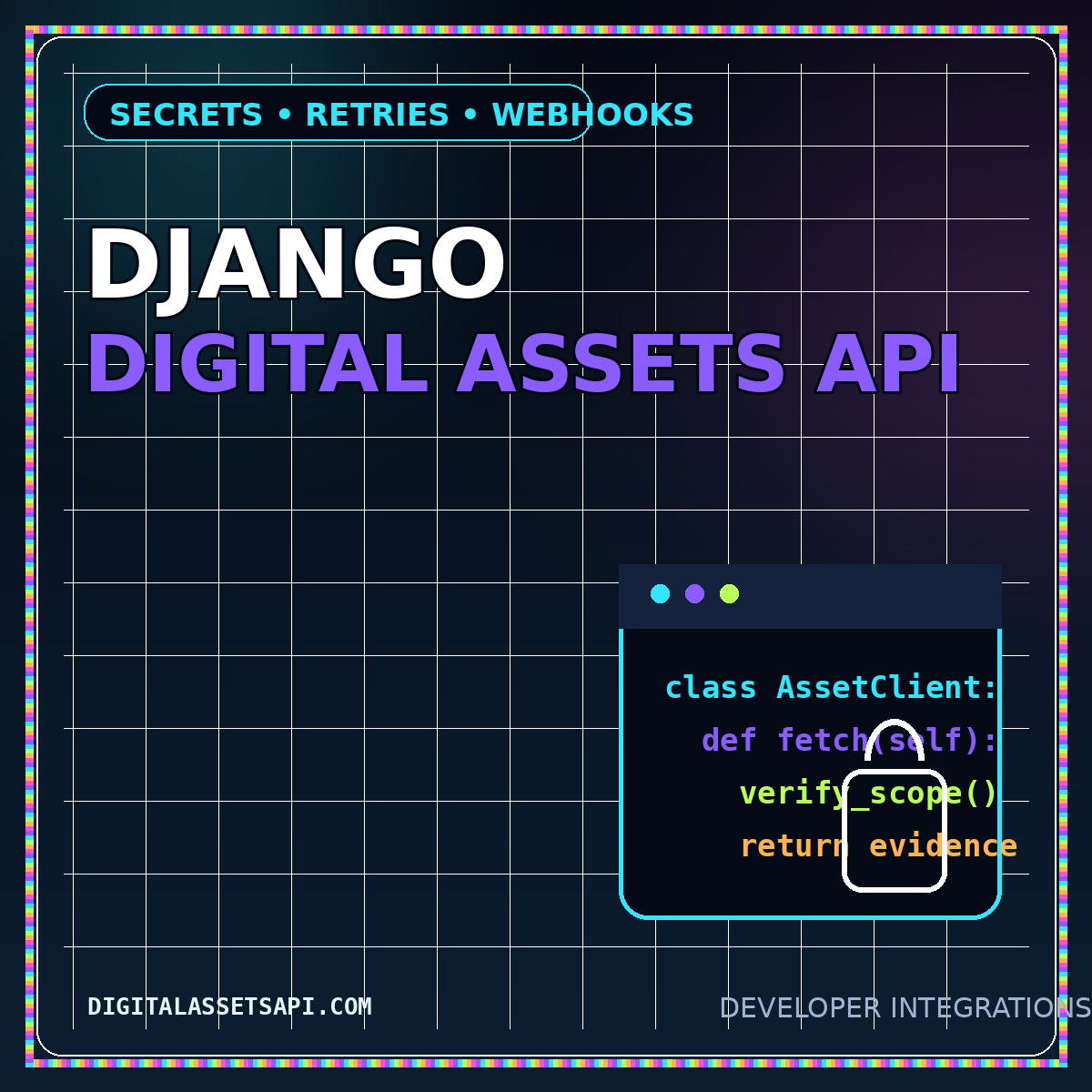
Django is a practical server boundary for a Digital Assets API app because it can keep provider credentials away from browsers and mobile bundles, enforce user permissions, normalize data, receive webhooks, and maintain an audit trail. The framework does not remove the need for careful API design. Financial and blockchain integrations amplify common web risks: duplicate writes, stale state, leaking secrets, unbounded retries, and trusting remote data too quickly.
This guide uses a layered design that works for market data, blockchain data, compliance checks, and lower-frequency trading workflows. It is intentionally provider-neutral. Replace illustrative resource names with the contract defined by your application.
Put provider access in a dedicated service layer
Do not scatter requests.get() calls through views, models, signals, and templates. Create a typed client module for each provider and a domain service that translates provider responses into your canonical models. Views should authorize the user and call the domain service; they should not know provider authentication details.
A simple package layout can separate concerns:
integrations/
  provider_x/
    client.py
    schemas.py
    errors.py
    webhooks.py
  market_data/
    services.py
    models.py
  blockchain/
    services.py
    models.py
The client owns base URLs, authentication, timeouts, request IDs, pagination, and provider error parsing. The domain service owns asset identity, business validation, and persistence. This makes it possible to replace a provider without rewriting every endpoint.
Keep secrets outside code and clients
Load API credentials from a secret manager or protected environment, not from source control. Use separate credentials per environment and workload. Read-only market-data keys should not share permissions with order or transfer keys.
Never send provider secrets to JavaScript, a WordPress front end, an iOS app, or an Android app. Those clients authenticate to Django. Django then checks application permissions and calls the provider. If the provider supports short-lived or scoped tokens, issue them only through a controlled backend flow.
The Django security documentation emphasizes a layered approach and careful handling of untrusted input. Treat provider payloads, webhook bodies, uploaded addresses, and user-selected symbols as untrusted data. Validate types, lengths, formats, and allowed values before storing or rendering them.
Configure explicit timeouts and bounded retries
Every outbound request needs a connection timeout and a read timeout. A missing timeout can consume workers indefinitely during a provider incident. Choose deadlines based on the user workflow: a page request may have a few seconds, while a background backfill can wait longer.
Retry only transient conditions such as selected network failures, rate limits, or server errors. Use exponential backoff with jitter and a maximum attempt count. Do not automatically retry non-idempotent writes unless the provider supports an idempotency key or you can reconcile the result.
Create an error hierarchy such as AuthenticationError, RateLimitError, InvalidRequestError, ProviderUnavailable, StaleDataError, and UnknownWriteState. Map provider responses into these categories and keep the original response safely in logs or an evidence store.
Use one resilient HTTP transport
Configure a shared HTTP session or async client with connection pooling, default headers, tracing, and redaction. Generate a correlation ID for every application request and propagate it to provider requests where supported. Record provider request ID from the response.
Centralize rate-limit information. A response may include remaining quota or reset time. Feed it into a scheduler rather than allowing every view to retry independently. For expensive endpoints, use a queue and return a job resource instead of holding an HTTP request open.
Validate JSON against explicit schemas. A provider can add fields, change nullability, or return an HTML error page through a proxy. Fail with a typed parsing error rather than storing malformed data as if it were valid.
Model raw and normalized records separately
Store original provider records in an append-only table or object store with provider, endpoint, received time, content hash, schema version, and correlation ID. Then store normalized domain objects such as assets, markets, blocks, transfers, orders, or screening decisions.
Use database uniqueness constraints for stable provider IDs. Idempotency should be enforced by the database as well as application code. For blockchain events, a compound key might include network, transaction identifier, and event index.
Avoid placing frequently changing external state directly on Django user models. Use related account and integration models with explicit ownership and permission checks. Encrypt sensitive tokens at rest and design rotation before production.
Cache by meaning, not convenience
Reference metadata can be cached longer than quotes or account balances. Key a blockchain state cache by block or slot when reproducibility matters. Cache user-specific data only with a user or account scope.
Do not return an empty response when the cache is stale and the provider is unavailable. Return the last known value with observed_at and is_stale, or return a typed unavailable state according to product policy. The client should be able to distinguish zero from unknown.
Use cache locks or request coalescing so a popular symbol does not trigger hundreds of identical upstream calls after expiration. Add jitter to expiration times to avoid synchronized refresh spikes.
Move backfills and reconciliation out of the request path
Historical imports, tax reconstruction, blockchain indexing, and large account reconciliations belong in background tasks. A task should have an idempotent key, durable cursor, progress, status, and retry policy. Split work into bounded chunks so a failure does not repeat an entire year of data.
Django’s process should enqueue work; a separate worker executes it. Persist checkpoints after complete chunks. When the task resumes, it should verify the last boundary and deduplicate overlapping records.
Show users honest progress: queued, running, waiting for provider, partially complete, failed, or complete. Avoid displaying 100 percent when unresolved records or source gaps remain.
Receive webhooks defensively
Read the raw request body before parsing and verify the provider signature using the documented algorithm. Check timestamp tolerance and event ID to prevent replay. Reject oversized bodies and unsupported content types.
Persist the event before processing, then acknowledge quickly if the provider expects a short response time. A worker can apply domain changes. Use a unique constraint on provider and event ID so redelivery is harmless.
Webhook order is not guaranteed. Fetch the current resource when necessary, and design state transitions to accept a late event without moving an object backward incorrectly. Keep invalid-signature and parsing failures in a security log with redacted bodies.
Design Django endpoints for web and mobile clients
Expose your own stable resources rather than proxying provider JSON. Use pagination, field selection where justified, explicit timestamps, and consistent error objects. Return canonical asset IDs and display metadata so iOS and Android clients do not maintain separate symbol maps.
For live data, use a backend stream gateway or managed messaging layer. Authenticate subscriptions and authorize each account or market. Do not open one provider WebSocket per browser tab. Centralize upstream streams and fan out normalized events.
Apply throttles per user and endpoint. Throttling is not a complete security control, but it limits accidental overload. Protect administrative and write endpoints with stronger authentication and step-up approval where appropriate.
Test contracts and failures
Write unit tests for authentication signing, pagination, decimal parsing, timestamps, and error mapping. Use captured fixtures with sensitive values removed. Add contract tests against a sandbox or controlled mock that can simulate rate limits, malformed responses, duplicates, and timeouts after write acceptance.
Test database constraints by delivering the same webhook twice. Test reconciliation after a worker crashes between provider fetch and checkpoint commit. Test stale-cache behavior and permission boundaries between users.
For trading or transfer flows, require a dry-run or policy check and test idempotency keys. A successful HTTP response is not enough; verify the resulting provider state through a read path.
Observe the integration as a product
Metrics should include request latency by provider and endpoint, error category, retry count, rate-limit headroom, cache age, webhook lag, task backlog, stale responses, normalization failures, and reconciliation differences. Logs need correlation IDs and redaction.
Create operational dashboards and alerts for sustained gaps rather than every single transient error. A provider may return 200 responses while data timestamps stop advancing, so monitor freshness as well as availability.
The developer integrations overview connects Django to WordPress, iOS, Android, charting, and AI consumers. The API architecture guide describes the canonical contract this service layer should implement.
Conclusion
A secure Django integration is a controlled translation layer. It keeps secrets server-side, applies explicit timeouts and idempotency, separates raw evidence from normalized models, moves heavy work to resumable tasks, verifies webhooks, and exposes a stable contract to clients. Those practices matter more than the choice of HTTP library because they determine whether the application remains accurate and recoverable when providers and networks behave unpredictably.